A document to read. A form to answer.
Some forms need more than a label above a box. Zunoform’s document form builder puts headings, explanatory text and questions on one page, so respondents can understand the request while they complete it. Create document-style forms on Free, with 500 responses per month.
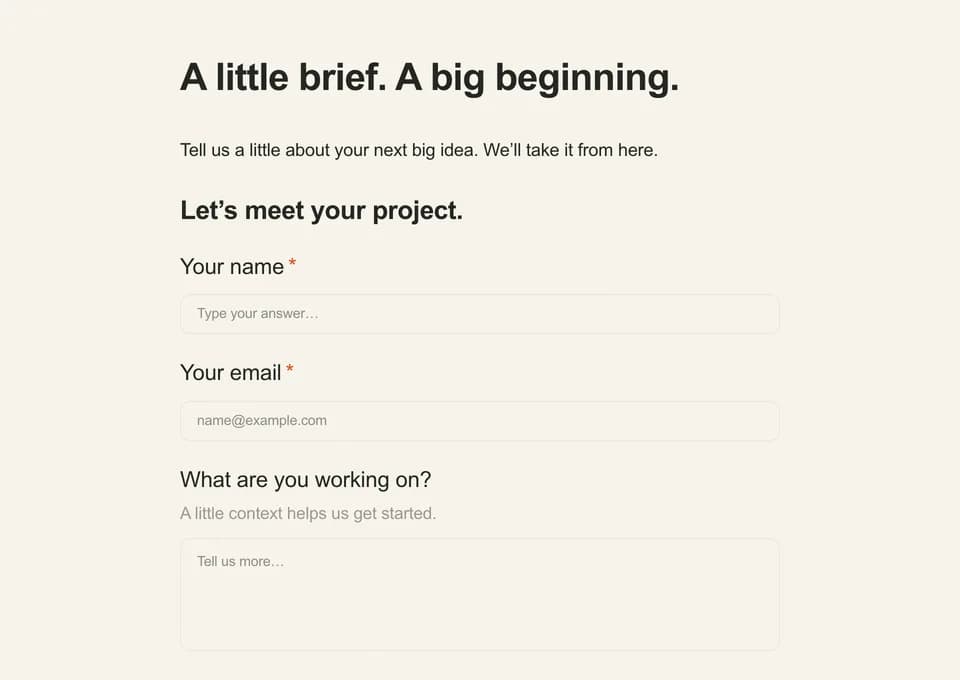
What is a document-style form?
It is an online page that combines editable text blocks with structured input fields. A paragraph can explain a project before a question asks for its timeline. A heading can introduce a new section. The answers still arrive as form responses rather than a document someone has to email back.
This is useful for client briefs, applications and internal requests where people need context. A short signup with two fields may work better as a single-page form; a guided survey may work better as a conversation. Choose Document when reading is part of the task.
Build a brief people can work through
Open with the purpose
Say what the form is for and what will happen after submission. If respondents need a file or an exact reference, tell them before they start.
Group questions under meaningful headings
Use sections such as “About the project,” “Timing” and “Supporting files.” Headings should describe the next set of questions rather than decorate the page.
Keep instructions near the relevant field
Explain a file request beside the upload field. Put an example beside a question that is easy to misunderstand. Avoid making respondents remember a paragraph from the top of the page.
Create a document form in Zunoform
From Create form, choose Document. Write the page content and insert questions where answers belong. Use text blocks for headings, paragraphs, quotes or callouts, and field blocks for structured answers. The document editor also supports inline fields for short answers within a sentence.
For an agency brief, start with an introduction, add a section for contact details, then ask about the goal, timing and supporting materials. Mark only the information you need before the next conversation as required. Preview the page at phone width before publishing.
Choose the right format for the job
| Need | Useful starting point | Reason |
|---|---|---|
| A brief with explanations | Document | Text and questions share a readable page. |
| A quick signup or repeated request | Single-page | Respondents can scan the fields together. |
| A guided survey or quiz | Conversational | One question gets attention at a time. |
| An existing PDF that must keep its exact layout | A dedicated PDF editor | A web document form is not a PDF overlay. |
Document form does not mean PDF converter
Zunoform’s Document layout is a web form. It does not import an arbitrary PDF and preserve its print layout, generate a signed PDF from each response, or act as a collaborative word processor. Recreate the content as text and fields when you need a web-based answering experience.
The current AI composer creates a form draft; it does not compose the document block layout for you. If your main requirement is automatic PDF conversion or document generation, evaluate a tool built for that job.
Publish the page and make the ending useful
Publish the form, then share its link or embed it on a website. Test an embed on the intended site: a restrictive online HTML preview can block resources and is not the same environment as a published page.
Use an ending page to acknowledge the response and explain the next step. You can show only a closing message, add a button with your own label and link, or enable the available sharing options. Quiz score and answer-reveal settings are relevant when the form is configured as a quiz.
The free plan covers the document layout and core fields. Publishing payment, signature or NPS fields requires Pro or Business. Custom domains and AI generation are Business features; choosing a document layout does not change those plan requirements.
Make the instructions understandable
W3C’s form guidance recommends providing instructions that help people understand what input is expected. Use visible labels and nearby explanations; a placeholder inside an empty field should not be the only instruction. Test your actual content and field configuration with the people who will use it.
Source: W3C WAI: Form Instructions
Questions people ask
Is the document form builder free?
Yes. The Document layout, core fields, templates and up to 500 responses per month are available on Free. Some fields and account features require a paid plan.
Can I add questions between paragraphs?
Yes. Document forms use text blocks and field blocks. You can place headings and explanations before or between questions, and use supported inline fields inside text.
Can I convert a PDF into a document form automatically?
Zunoform does not provide arbitrary PDF-to-form conversion. Its Document layout lets you build an online form using text and questions.
Is a document form always better than a conversational form?
No. It works well when context and reading matter. A conversational layout suits guided questions, while a single-page layout is useful for short or repeated requests.
Keep reading
Better forms.
Better data.
Start with a conversation, a document or a single page. Unlimited forms and 500 responses per month on Free. No card required.